I have recently seen page www.axacore.com and I will tell you some information about their production. Their company sells fax machines and interaction between you and others via fax.
Their FaxAgent has the EASY-TO-ADMINISTRATE system, where you can easily track persons using it, create profiles or automatic creating profiles. FaxAgent is centrally managed with this system and its easy to handle with it. Useful feature is FoIP, that means Fax-over-IP, so you do not need a dedicated fax hardware.
Lots of support like: multifunction printers, normal printers, copiers, mainframe servers, desktops digital senders etc.
I recommend you FaxAgent with digital interface, but if you want the least cost, then you should buy one with VoIP interface.
ORDER right now from WWW.AXACORE.COM, nobody knows when the prices would start to rise.
If you have some questions or you want some help with understanding these things, leave here a comment.
Sunday, December 2, 2007

Wednesday, November 21, 2007
GeForce ASUS EN8800 GTS
I have recently bought my new graphic card. I wanted to buy a cheaper high-end card. I wanted this one, because it offers a great results. I am going to explain you why. It is because the graphic card has a 320-bit bus. I dont recommend you to buy that 640MB version, if you dont have money to waste. And in conclusion with Radeon I think, that Radeon is not good enought right now to make the gamers satisfied. It runs great with my configuration, which is an old AMD Athlon 3000+ OC, 1,5GB RAM DDR and MB ASUS A8n-SLI Deluxe. I played games like Settlers IV and Half-Life 2 Episode Two on it and it runs without any problems, even if I set graphics to maximum. I also recommend you to buy this card after some new release from GeForce, or at least after the Chrismas time, because the card is overvalued right now.
Wednesday, October 24, 2007
AMD Athlon 64 X2 5000+ Black Edition
The "Black Edition" of AMD's Athlon 64 X2 5000+ features an unlocked multiplier. Unlike the first Black Edition model, the 90nm 6400+, the new processor is produced on a 65 nm process. As a result, it only draws about half as much power as the 6400+, and offers enormous overclocking potential. Pushed to its limit, this processor is faster than an Athlon X2 6000+ or Intel's Core 2 Duo E6550. Among today's CPUs, this $130 processor is unique in that its performance can be increased without having to raise either the FSB or the memory frequency, making it a safe choice for any AM2 board.
What makes the 5000+ Black Edition especially interesting, aside from the unlocked multiplier, is that it uses the newly introduced G2 stepping. This refined processor stepping allows the processor to stay stable at higher clock speeds without requiring an increase in core voltage. The obvious benefit is that you can put an inexpensive overclocked AMD processor into your PC, and the CPU fan won't need to run at speeds that make it sound like a turbine. Thus, thanks to the low thermal power dissipation, you don't need to spend extra money on a complex cooling solution.
What makes the 5000+ Black Edition especially interesting, aside from the unlocked multiplier, is that it uses the newly introduced G2 stepping. This refined processor stepping allows the processor to stay stable at higher clock speeds without requiring an increase in core voltage. The obvious benefit is that you can put an inexpensive overclocked AMD processor into your PC, and the CPU fan won't need to run at speeds that make it sound like a turbine. Thus, thanks to the low thermal power dissipation, you don't need to spend extra money on a complex cooling solution.
Monday, August 27, 2007
A $900 Graphics Card
How much would you spend for the peak of performance? For $900, Leadtek claims its Leviathan GeForce 8800 Ultra is in a class of its own. After we saw it at Computex this year, we were happy to get our hands on one to see if it lived up to the firm's bragging rights.
Nvidia's default clock speeds for its Ultra line of GeForce 8800 is 612 MHz for the core clock, 1500 MHZ for the shader clock and 1080 MHz for the GDDR3 memory (2160-MHz DDR). Seeking to launch the fastest card on the market, Leadtek bundled a custom-cooling solution to ensure the device could remain stable while running at the highest frequencies possible.
With its special maintenance-free water cooling unit, the Leviathan ships at a core clock of 684 MHz, which is 72 MHz above the Ultra's already aggressive overclock of the G80 processor. GeForce 8800 GTX runs at 575 MHz and this is over 100 MHz faster. The memory clock was raised slightly to 1161 MHz (2322 MHz DDR). While it may not be a large overclock, that represents a 7.5% overclock for the memory modules and 11.7% for the core. The shaders run at the same frequency as the stock Ultra at 1500MHz.
How much would you spend for the peak of performance? For $900, Leadtek claims its Leviathan GeForce 8800 Ultra is in a class of its own. After we saw it at Computex this year, we were happy to get our hands on one to see if it lived up to the firm's bragging rights.
Nvidia's default clock speeds for its Ultra line of GeForce 8800 is 612 MHz for the core clock, 1500 MHZ for the shader clock and 1080 MHz for the GDDR3 memory (2160-MHz DDR). Seeking to launch the fastest card on the market, Leadtek bundled a custom-cooling solution to ensure the device could remain stable while running at the highest frequencies possible.
With its special maintenance-free water cooling unit, the Leviathan ships at a core clock of 684 MHz, which is 72 MHz above the Ultra's already aggressive overclock of the G80 processor. GeForce 8800 GTX runs at 575 MHz and this is over 100 MHz faster. The memory clock was raised slightly to 1161 MHz (2322 MHz DDR). While it may not be a large overclock, that represents a 7.5% overclock for the memory modules and 11.7% for the core. The shaders run at the same frequency as the stock Ultra at 1500MHz.
Sunday, August 12, 2007
Logitech G9
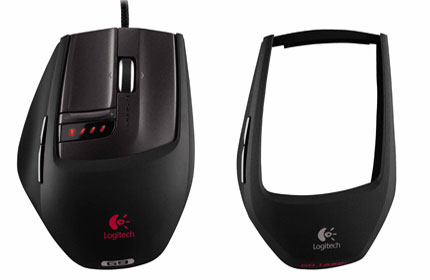
Last week Logitech announced its newest G-series gaming mouse, the G9 Laser Mouse. The new peripheral is designed to take mouse customization to a new level with two inter-changeable grips. Logitech had the G9 available for private viewings during E3 2007 last month, and I had a chance to play around with the new mouse, which is scheduled to go on sales in September.
First and foremost, the corded G9 has a range adjustable dpi range between 200 and 3,200, and gamers can alter the settings on the fly without having to install a driver. A full-speed USB connection delivers up to 1,000 reports per second for smooth tracking without cursor lag, and a color LED shows the sensitivity level and profile settings. With Logitech's SetPoint 5.0 software, the G9 also saves settings in onboard memory and can store up to five separate profiles with keyboard macros, dpi settings and LED color. Players don't have to install SetPoint on multiple computers to access the profiles on different machines.
The Logitech G9 Laser Mouse
Players can adjust the weight of the mouse with up to 28 grams of metal weights that are stored in the mouse's spring-loaded weight cartridge. The G9 also features Logitech's MicroGear Precision Scroll Wheel, which was introduced last year in the Logitech MX Revolution cordless laser mouse. The wheel can be used for click-to-click weapon selection or set to frictionless scrolling for faster zooming or scrolling. And the G9 has Polytetrafluoroethylene feet for a smooth glide.
But the real trick here is the G9's customization feature, which boasts two inter-changeable grips. The larger Wide Load Grip has a satin feel with wider shape, while the smaller Precision Grip features a DryGrip surface for a better handle and a more compact shape for enhanced fingertip control. The grips are easily removed and fastened to the mouse, and once they're snapped in place there's no wiggle room or looseness. The grips also felt like they were made from durable, quality material; in other words, I didn't have any fear that removing and adding the grips would result in them cracking or snapping like a cheap plastic toy.
The G9 Laser Mouse comes with the Wide Load Grip and Precision Grip.
I played around with both grips and each one had its advantages, though as someone with large hands I preferred the Wide Load overall (feel free to make as many jokes as you'd like). It was comfortable and the button placements and scroll wheel were ideally placed. Even though the grips were add-ons, it never felt like they were separate from the base mouse. It would have been great to have a Wide Load Grip with the Precision's DrypGrip surface, and I may get my wish at some point down the road; Logitech says it plans on releasing additional grips at later dates. Unfortunately, I didn't adjust the weight settings as I was too busy getting acclimated with the grips.
I'll reserve my full verdict on the G9 until I can spend more than a few minutes with the mouse. But from what I've seen - and felt - so far is promising. Some might question the need for removable grips, but the Wide Load and Precision grips offer an attractive variety, depending on your style of gameplay, hand size and mouse preference. I'm looking forward to playing with the G9 more and seeing what other grip styles the company can produce. The G9 Laser Mouse is expected to go on sale in September for an MSRP of $99.99.

First and foremost, the corded G9 has a range adjustable dpi range between 200 and 3,200, and gamers can alter the settings on the fly without having to install a driver. A full-speed USB connection delivers up to 1,000 reports per second for smooth tracking without cursor lag, and a color LED shows the sensitivity level and profile settings. With Logitech's SetPoint 5.0 software, the G9 also saves settings in onboard memory and can store up to five separate profiles with keyboard macros, dpi settings and LED color. Players don't have to install SetPoint on multiple computers to access the profiles on different machines.
The Logitech G9 Laser Mouse
Players can adjust the weight of the mouse with up to 28 grams of metal weights that are stored in the mouse's spring-loaded weight cartridge. The G9 also features Logitech's MicroGear Precision Scroll Wheel, which was introduced last year in the Logitech MX Revolution cordless laser mouse. The wheel can be used for click-to-click weapon selection or set to frictionless scrolling for faster zooming or scrolling. And the G9 has Polytetrafluoroethylene feet for a smooth glide.
But the real trick here is the G9's customization feature, which boasts two inter-changeable grips. The larger Wide Load Grip has a satin feel with wider shape, while the smaller Precision Grip features a DryGrip surface for a better handle and a more compact shape for enhanced fingertip control. The grips are easily removed and fastened to the mouse, and once they're snapped in place there's no wiggle room or looseness. The grips also felt like they were made from durable, quality material; in other words, I didn't have any fear that removing and adding the grips would result in them cracking or snapping like a cheap plastic toy.
The G9 Laser Mouse comes with the Wide Load Grip and Precision Grip.
I played around with both grips and each one had its advantages, though as someone with large hands I preferred the Wide Load overall (feel free to make as many jokes as you'd like). It was comfortable and the button placements and scroll wheel were ideally placed. Even though the grips were add-ons, it never felt like they were separate from the base mouse. It would have been great to have a Wide Load Grip with the Precision's DrypGrip surface, and I may get my wish at some point down the road; Logitech says it plans on releasing additional grips at later dates. Unfortunately, I didn't adjust the weight settings as I was too busy getting acclimated with the grips.
I'll reserve my full verdict on the G9 until I can spend more than a few minutes with the mouse. But from what I've seen - and felt - so far is promising. Some might question the need for removable grips, but the Wide Load and Precision grips offer an attractive variety, depending on your style of gameplay, hand size and mouse preference. I'm looking forward to playing with the G9 more and seeing what other grip styles the company can produce. The G9 Laser Mouse is expected to go on sale in September for an MSRP of $99.99.
Tuesday, July 31, 2007
Kingston DDR3 HyperX Memory
 Kingston Technology has announced it's second product in the DDR3 overclocking market -- ultra low-latency PC3 1375MHz DDR3 HyperX memory modules.
These are also the first production DDR3 modules to achieve CL5 at PC11000 frequencies (1375MHz), according to Kingston.
Rajesh Panicker, country manager India, Kingston Technology, said, "Our new HyperX DDR3 ultra low-latency modules give early adopters and performance enthusiasts the opportunity to push their DDR3 motherboards as far as current memory technology will allow. With new chipsets on the horizon, Kingston is positioning HyperX to be the go-to memory for all DDR3 needs for gaming and mainstream systems."
Lower CAS latencies deliver better performance without driving thermal conditions that require extra cooling in a system, Panicker said.
The ultra low-latency HyperX is shipping in 1GB modules and 2GB memory kits. The 1GB 1375MHz DDR3 Ultra Low-Latency HyperX DIMM is available for Rs 23,500. Whereas the 2GB 1375MHz DDR3 Ultra Low-Latency HyperX DIMM -- Kit of 2, is available for Rs 47,000.
The DDR3 memory is available from Avnet India, Ingram Micro, Kobian Electronics, and Transtek Infoways. It comes with a lifetime warranty and free technical support.
Wednesday, June 20, 2007
Comparation - G80 GeForce cards
GeForce 8800 GTX
Processor: G80
Fabrication Process: 90 nm
Number of Transistors (millions): 681
Core Clock (Including dispatch, texture units, ROP units): 575 MHz
Memory Clock (MHz / data rate): 900/1800
Memory Interface: 384 Bits
Frame Buffer Size (RAM): 768 MB
GeForce 8800 GTS
Processor: G80
Fabrication Process: 90 nm
Number of Transistors (millions): 681
Core Clock (Including dispatch, texture units, ROP units): 500 MHz
Memory Clock (MHz / data rate): 800/1600
Memory Interface: 320 Bits
Frame Buffer Size (RAM): 640 MB
GeForce 8600 GTS
Processor: G84
Fabrication Process: 80 nm
Number of Transistors (millions): 289
Core Clock (Including dispatch, texture units, ROP units): 675 MHz
Memory Clock (MHz / data rate): 1000/2000
Memory Interface: 128 Bits
Frame Buffer Size (RAM): 256 MB
GeForce 8600 GT
Processor: G84
Fabrication Process: 80 nm
Number of Transistors (millions): 289
Core Clock (Including dispatch, texture units, ROP units): 540 MHz
Memory Clock (MHz / data rate): 700/1400
Memory Interface: 128 Bits
Frame Buffer Size (RAM): 256 MB
GeForce 8500 GT
Processor: G86
Fabrication Process: 80 nm
Number of Transistors (millions): 210
Core Clock (Including dispatch, texture units, ROP units): 450 MHz
Memory Clock (MHz / data rate): 400/800
Memory Interface: 128 Bits
Frame Buffer Size (RAM): 256 MB
GeForce 8400 GS
Processor: G86
Fabrication Process: 80 nm
Number of Transistors (millions): 210
Core Clock (Including dispatch, texture units, ROP units): 450 MHz
Memory Clock (MHz / data rate): 400/800
Memory Interface: 64 Bits
Frame Buffer Size (RAM): 128 MB or 256 MB
GeForce 8300 GS
Processor: G86
Fabrication Process: 80 nm
Number of Transistors (millions): 210
Core Clock (Including dispatch, texture units, ROP units): 450 MHz
Memory Clock (MHz / data rate): 400/800
Memory Interface: 64 Bits
Frame Buffer Size (RAM): 128 MB or 256 MB
Processor: G80
Fabrication Process: 90 nm
Number of Transistors (millions): 681
Core Clock (Including dispatch, texture units, ROP units): 575 MHz
Memory Clock (MHz / data rate): 900/1800
Memory Interface: 384 Bits
Frame Buffer Size (RAM): 768 MB
GeForce 8800 GTS
Processor: G80
Fabrication Process: 90 nm
Number of Transistors (millions): 681
Core Clock (Including dispatch, texture units, ROP units): 500 MHz
Memory Clock (MHz / data rate): 800/1600
Memory Interface: 320 Bits
Frame Buffer Size (RAM): 640 MB
GeForce 8600 GTS
Processor: G84
Fabrication Process: 80 nm
Number of Transistors (millions): 289
Core Clock (Including dispatch, texture units, ROP units): 675 MHz
Memory Clock (MHz / data rate): 1000/2000
Memory Interface: 128 Bits
Frame Buffer Size (RAM): 256 MB
GeForce 8600 GT
Processor: G84
Fabrication Process: 80 nm
Number of Transistors (millions): 289
Core Clock (Including dispatch, texture units, ROP units): 540 MHz
Memory Clock (MHz / data rate): 700/1400
Memory Interface: 128 Bits
Frame Buffer Size (RAM): 256 MB
GeForce 8500 GT
Processor: G86
Fabrication Process: 80 nm
Number of Transistors (millions): 210
Core Clock (Including dispatch, texture units, ROP units): 450 MHz
Memory Clock (MHz / data rate): 400/800
Memory Interface: 128 Bits
Frame Buffer Size (RAM): 256 MB
GeForce 8400 GS
Processor: G86
Fabrication Process: 80 nm
Number of Transistors (millions): 210
Core Clock (Including dispatch, texture units, ROP units): 450 MHz
Memory Clock (MHz / data rate): 400/800
Memory Interface: 64 Bits
Frame Buffer Size (RAM): 128 MB or 256 MB
GeForce 8300 GS
Processor: G86
Fabrication Process: 80 nm
Number of Transistors (millions): 210
Core Clock (Including dispatch, texture units, ROP units): 450 MHz
Memory Clock (MHz / data rate): 400/800
Memory Interface: 64 Bits
Frame Buffer Size (RAM): 128 MB or 256 MB
Subscribe to:
Comments (Atom)